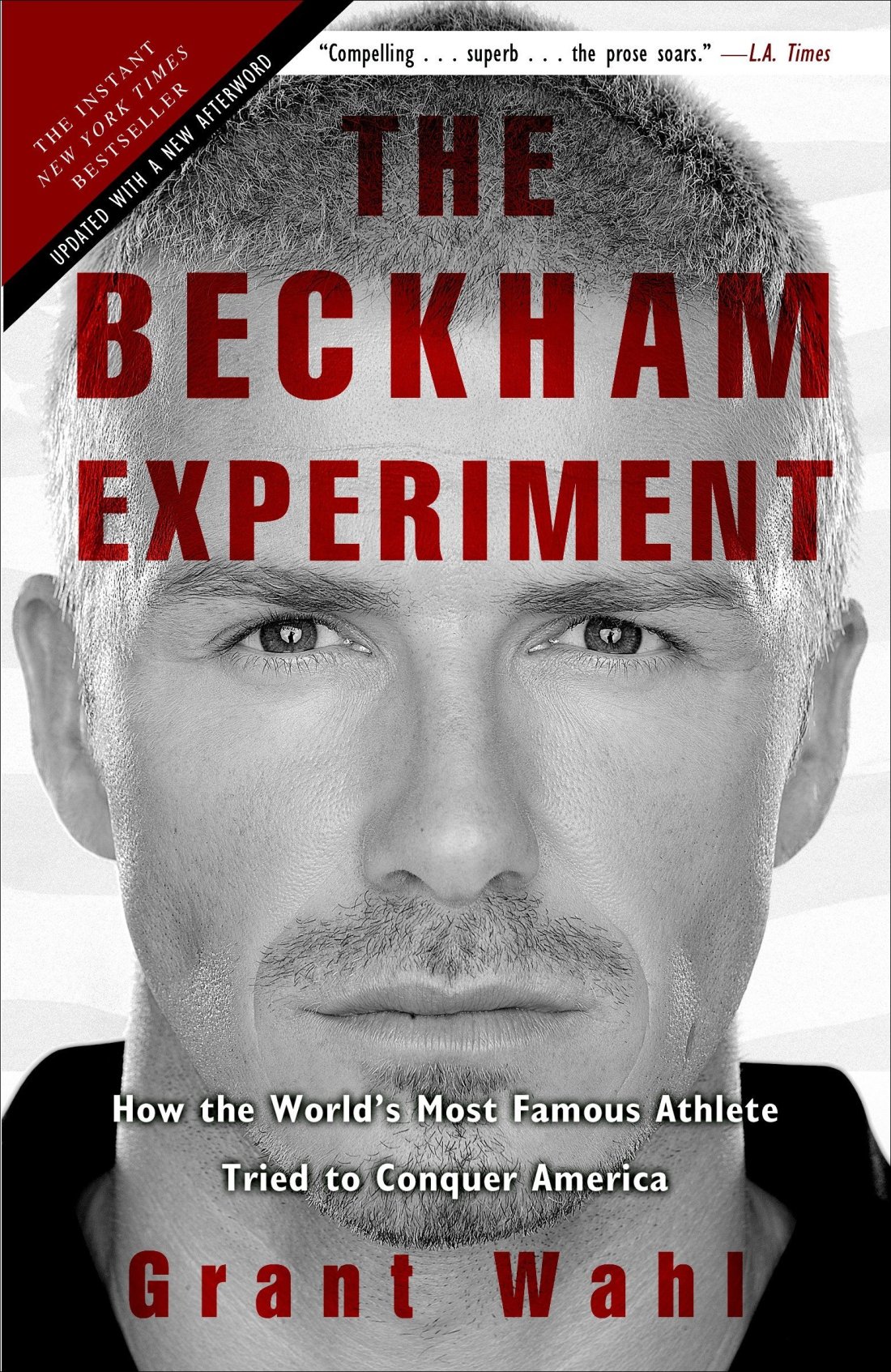
‘The Beckham Experiment: How the World’s Most Famous Athlete Tried to Conquer America’ by Grant Wahl (2009)

When David Beckham signed for LA Galaxy in Major League Soccer in 2007 it was big news.  Wall to wall coverage on Sky Sports News and hundreds of newspaper articles pontificating on what this meant for the further of soccer in the US of A.   The whole thing seemed to be hyped beyond all measure largely due to Beckham’s celebrity profile rather than his footballing ability.

Looking back now, my gut feeling was that Beckham was partly successful.  Everyone became a little bit interested, further big names followed – including the legendary Robbie Keane – but no-one in Europe actually watched any MLS apart from the odd youtube highlight. Whether the game has grown in the US, I have no idea – but the recent failure to qualify for the Russia World Cup suggests any benefits are been seen by the national team.

For The Beckham Experiment Grant Wahl was given great access to follow Beckham’s first two seasons at the Galaxy.  Reading the book, I was shocked to realise how spectacular a failure those first few seasons were, from a sporting sense at least.  Injuries, fatigue, lack of effort all played a part in the Galaxy having their worst two seasons in the club’s (I can never call a team a ‘franchise’) history.

Wahl paints the picture of an experiment that was a commercial success but – at that point – a sporting failure.  Beckham’s management team were given way too much influence over club affairs, Beckham was made captain despite not having a desire to be the team’s actual leader, and the approach of blowing the budget on Beckham and Landon Donovan left the team hopelessness unbalanced.  Indeed, I was shocked to see just how little some of his teammates earned, with one promising teammate even quitting the game to make more money in a ‘real’ job.

USA 94 legend Alexi Lalas is very much at the centre of the book – the former General Manager was clearly happy to use the book to vent his feelings about how his tenure at the Galaxy went.   The most interesting insights for me were just how different Major League Soccer is from the game played elsewhere with drafts, salary caps and squad limits that make it a unique coaching and management challenge.

Beckham is painted as either secretly manipulative or willfully naive as his team effectively took over the club, ensuring he was made captain and installing Ruud Guilit as manager.  We never get a strong sense of who Beckham is but this is no fault of Wahl’s who gets the other key protagonists to open up in great detail.  Indeed, Donovan may have regretted how open he was when he ultimately had to apologise to Beckham for the candid views he expressed in the book.  On balance, his teammates are reported to have viewed Beckham as a good teammate but a bad captain – a hard worker who wanted to win but someone who was distant from them by virtue of his fame and his wealth.

Overall the book provides a great insight into the state of MLS at the time.  While I’ve attended a couple of MLS games whenever I’m in the States and watched plenty of Robbie Keane highlights over the years, I don’t know enough to know whether the league has progressed.  It has whet my appetite for other books on the modern game in the US (I love books on the old NASL days such as Once in A Lifetime on the New York Cosmos).

Overall, it’s probably a little out of date to be of major interest to most readers still.  But it’s a highly readable, well-written and well-reported book and I’m looking forward to checking out Wahl’s most recent book Football 2.0.  I definitely have a natural bias against US based soccer journalists given the use of different terminology instantly jars, but this book was definitely well worth checking out.

I’ve also recently checked out Wahl’s podcast Planet Futbol which has some really interesting episodes.
wahl.jpg

One Career, Two Books – Tony Adams. Addicted (1999) and Sober (2017) written with Ian Ridley

The titles of former footballer Tony Adams’ two books make clear how his struggles with addiction have shaped large part of his life.

addicted

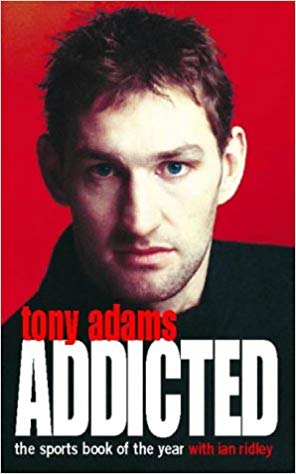
Addicted was published in 1999 when Adams was still Arsenal and England captain, and less than 3 years after he had revealed his alcoholism and stopped drinking.  At the time it garnered a lot of attention as Adams discussed his career and his battles with alcoholism in stark detail.  It was a striking honest book from a footballer still playing at the highest level.

Addicted covers all of the key aspects of Adams life in different chapters – his addiction battles, his Arsenal career, his England career, the managers he worked with, and the players he played with are all given their own space rather than following a more straightforward chronology.  It works well but does mean there is some repetition – particularly of his England career which inevitably is also discussed as he goes through his Arsenal days season by season.

Adams portrays his younger self as fairly self-involved and oblivious to the world around him.  He shudders to recall how little the Hillsborough tragedy affected him and acknowledges he hypocritically judged players like Charlie Nicholas who, like Adams, enjoyed life outside football a bit too much.

Don Howe and George Graham emerge as the key figures of influence on Adams career – Howe as coach from his early days and Graham as the manager who made him captain and under whom Adams won two Championship titles as well as 4 cup competitions.

However, more than football, addiction and alcohol are at the centre of the book.  It reads largely as Adams’ own attempt to figure himself out. which makes it more interesting than a standard football biography.   It’s a fascinating and at times harrowing read.

I first read it back when I was 17 and shortly to start out on my own booze filled college days.  At the time I had no real appreciation of alcohol but remember being shocked at how an alcoholic could play football to such a high level.

Re-reading it now, aged 34, and one year after giving up booze myself, I experienced the book quite differently – there is the relief of knowing Adams did manage to stay off the booze for the last 20 years combined with a much greater empathy for the attraction that booze had for him.  I enjoyed the book even more this time.

Sober, published last year, picks up where Addicted left off and covers the last 5 years of Adams playing career and his life thereafter.  Sharing the same ghostwriter, Ian Ridley, means that both books have the same voice.  There are some clear differences however.  Sober is more open about family and personal relationships with family members being much more fleshed out in the second book.

Sober

Sober uses the language of AA and recovery much more regularly as Adams has spent the last 20 years maintaining his sobriety.  It can feel a little much at times but it wouldn’t be Adams own voice if it didn’t.   Adams major post career achievement is the founding and ongoing survival of Sporting Chance, a charity dedicated to helping sportsmen and women with addictions.

The end of his playing career is told fairly quickly as Adams moves on to focus on the transition to his post-playing career.  While Addicted told the story of the Arsenal and England captain at the peak of his powers, Sober is mostly the story of an ex-player struggling to find the next step in his career.  It’s interesting to see how a former superstar deals with being less successful in the next phase of his career.

Adams took various courses and coaching badges before trying his hand at management with Wycome. After resigning there, he returned to education before joining Portsmouth as Harry Redknapp’s assistant during their high spending days that included an FA Cup victory.  He ultimately became manager after Harry left but appears to never had had much of a chance due to budget cuts before asking to be fired to save himself from resigning.

From here, Adams career took an odd, international turn.  After briefly coaching in Azerbaijan, he stepped into a general manager / consultant type role in building a small Azerbaijani team from the ground up.    This was followed by a connection with a Chinese football investor as Adams took on a general consulting role for Jiang Lizhang who owned a club in China and purchased Granada in Spain.  He even briefly became Granada manager for a while.

It’s clear Adams feels somewhat unfulfilled with his coaching and management career.  Sober gave me a much better impression of Adam’s post playing career than the easy narrative of failed manager which I suspect many fans of English football have.

Late in the book Sober becomes a series of musings about Arsenal, England, Wenger and the state of British football.  At times it becomes a bit boring and simply the musings of an ex footballer who is annoyed that he isn’t able to contribute more to the game in England at the highest levels.  Ultimately, the book ends as it begins with a reflection on addiction, recovery and staying sober.

Sober makes an excellent companion piece to Addicted but as a stand-alone book it’s good without being great.  While it is equally honest, particularly about Adams mental health struggles, it doesn’t reach the difficult task of living up to its predecessor.  The general musings on the game ultimately let the book down by going on that bit too long.

Overall, the two books together give an incredibly honest and interesting account of a man who achieved great things in the game, but none greater than achieving his sobriety and helping others achieve theirs.

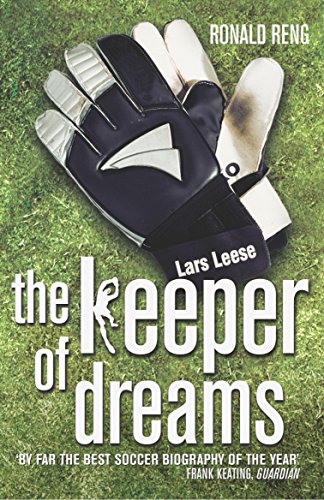
‘Keeper Of Dreams: One Man’s Controversial Story of Life in the English Premiership’ by Ronald Reng & translated by Shaun Whiteside (2002)

Ronald Reng will be best known to English readers for ‘A Life Too Short’ his excellent and heart-breaking biography of the late Robert Enke.

Keeper of Dreams is his much lesser known first book (first translated into English at least) about the brief professional career of Lars Leese, a German goalkeeper who was catapulted from lower league German football to become a Premier League goalkeeper during Barnsley’s one season in the top flight.

Lesse looked like he had missed his chance to be a professional before, at the age of 26, getting taken on as Leverkuson’s third choice goalkeeper.  A bit of luck and the right connection resulted in a surprise transfer to Barnsely where Lesse briefly became a starting Premier League goalie in only his second year as a pro.

Barnsley’s year in the top flight was in 1997/1998 – when I was 13 and utterly obsessed with football and Championship Manager.  That obsession can only explain why I have vivid memories of that Barnsely team and of Lars Lesse when I can barely remember matches I watched last week.

lars

Leese was something of a celebrity in Barnsley as the town went football crazy.   In the book he is very candid with his opinions on British life and Reng captures the bemusement of a foreigner in a British town as Lesse and his wife come to really enjoy their lives there.

Keeper of Dreams is ultimately the story of a dream temporarily lived and the frustration of coming to terms with the reality that the dream ended all too soon.  After eventually securing a starting spot and playing fanstically to secure a famous win at Anfield, Lesse lost his place due to illness and couldn’t get back into the team due to David Wagner’s great form.   As Barnsley dropped to Division 1, John Hendrie took over from Danny Wilson and Lesse found his face no longer fit with Hendrie’s plans for the club.  Released after his second year, Lesse struggled in vain to find a new club before eventually seeking normal work and stability back in Germany.

Reng is excellent at capturing the more difficult side of life in football – the personal struggle players experience behind closed doors.  It is impossible to read this book now without seeing the writing of this story as part of Reng’s development as a writer and his experiences with Reng can only have helped him to so brilliantly capture the tragic story of Robert Enke in his universally admired A Life Too Short –  a book I thought was just superb but am hesitating to reread and review given the sad subject matter.

Keeper of Dreams is a pretty quick and easy read that captures a fairly unique football journey and an interesting and honest character in Lars Lesse.  Well worth picking up.

keeper


‘Bayern: Creating a Global Superclub’ by Uli Hesse (2016)

When I first started reading sports books that weren’t just focused on Irish or British stories, Tor!: The Story of German Football was one of the first that opened my eyes to the wider world of sports writing.  A detailed and engrossing history of German football, it’s definitely one for the sports history nerd rather than the casual premier league fan (needless to say I loved it).

Surprisingly, Uli Hesse didn’t publish his next book on German football for 13 more years.  Bayern: Creating a Global Superclub tells the history of Bayern Munich, the undisputed biggest club in Germany and one of the true global superclubs that competes for the Champions League (almost) every season.

The club’s origin story is interesting and well-told.  Disgruntled players broke away from the local gymnastics club to ensure football got the attention they felt it deserved.  Of most interest is the clubs early openness to foreigners and its Jewish connections which saw it suffer during Hitler’s reign.  This could have been covered in more detail – especially as it’s not a short book.  Hesse alludes to mixed views on whether Bayern were victims or not and I would definitely like to read more about that period in the clubs history.

Its remarkable to think that Bayern weren’t invited into the inaugural Bundesliga in 1963 but within 10 years had won it 3 times and be about embark on an incredible run of 3 successive European Cups.

Throughout the book, Hesse tracks the key figures who helped turn the club from a normal Bavarian team into a global institution – players, coaches and administrators, and the likes of Uli Hoeness and Franz Beckenbauer who played multiple roles with such impact.

One fact that jumps out from the book is the relatively small impact that individual managers/coaches have had on Bayern’s historical development and achievements than players and administrators have had.  For instance, no-one would consider 2 time European Cup winner Dettmar Cramer in the same category as Brian Clough, Pep Guardiola, Alex Ferguson or Arrigo Sacchi – all fellow 2 time European Cup winners who had much greater personal influence and impact on the clubs that they managed.

Hesse approaches the book with the stated aim of being dispassionate about a club that German football fans either love or hate.  He definitely achieves this, and a lot more.  Bayern is meticulously researched and packed full of detail.  It’s a really interesting and enjoyable read.  Like Tor! however it may too full of detail for many readers (and incomprehensibly detailed for those without any past knowledge of Bayern).  Some readers may find there is too much emphasis on match report style recounts of long forgotten matches and others may wish there was more coverage of the recent era.  However, I definitely recommend it for anyone who likes a bit of football history.

German feature length documentary on Bayern’s history (English subtitles)

Hesse’s latest book, Building the Yellow Wall: The Incredible Rise and Cult Appeal of Borussia Dortmund was just published (in English at least) this week and is one I’ll be picking up. 

Bayern

‘Two Hours: The Quest to Run the Impossible Marathon’ by Ed Caesar (2015)

Two Hours is a comprehensive look at the world of men’s elite marathon running framed around the question of whether any man can run 26 miles and 365 yards in under two hours.

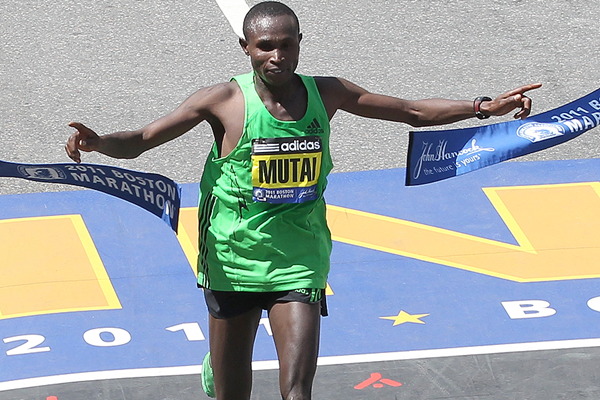
Two Hours is first and foremost a celebration of elite men’s marathon running.  While I expected the book to focus more heavily on the quest for lower and lower times, its actually much broader than that, and probably a better book for this broadness.  It combines the history of the marathon, a comprehensive look at the marathons raced between 2010 and 2013 and an in-depth focus on the career of 4 time major marathon winner Geoffery Mutai.  While it touches on all of the key things being considered in efforts to run a 2 hour marathon – shoe technology, genetics, doping etc – it doesn’t cover these in massive detail.

mutai

The years covered by Caesar ended up being really fascinating for marathon running – with the emergence of new superstars, world records and doping scandals – and the book benefits from the amazing access Caesar had to the athletes.  It’s pleasing that doping is addressed and Caesar’s insights into how doping appears to operate (at least for some athletes) in Kenya are interesting.  The insights gleaned from in-depth interviews with Mutai about his state of mind during races was also enlightening.  There are also interesting doubts cast on the ‘barefoot running’ craze popularised by the excellent Born to Run – Caesar observes that elites marathoners have been asking for more cushioning not less.

The one thing that I think was missing from the book was consideration of women’s marathon records – I think the fact that Paula Radcliffe held the women’s world record for so long (and still held it at the time of writing the book) would have been an interesting topic to consider when looking at both the progression of the men’s record during this time and the dominance of East African’s.

The book was finished before the launch of the academic led Sub2hrs project and was published before the launch of Nike’s Breaking2 Project which in 2017 saw Eliud Kipchoge run the distance in 2 hours and 25 seconds.  Caesar had speculated about the possibility of just such an attempt – but there is almost no mention of Nike in the book which talks much more about Adidas (as people from Adidas must have been willing to speak to Caesar). It is particularly interesting that the men’s world record, that must be set during an actual marathon meeting certain conditions, has not improved in the last 4 years – suggesting that a plateau has been reached for now?

Overall its a very enjoyable and easy read.  Caesar writes very well and is clearly passionate about the subject and fascinated by the athletes he meets. Highly recommended for anyone with an interest in distance running.

two hours

‘The European Game: An Adventure to Explore Football on the Continent and its Methods for Success’ by Dan Fieldsend (2017)

The European Game is a journey behind the scenes of  how European football operates.  Fieldsend, formerly a staff member at Liverpool, spent three months travelling to the best and most famous football teams across Europe learning along the way about the club’s history, key figures, tactical developments, and place in their society.

It’s a book that celebrates the uniqueness and specialness of every football club which shifts between understanding why how clubs impact their environment and how environment’s shape their clubs.  It’s part exploration of what makes a club successful and part exploration of what makes a club magical.

The book can be dipped into chapter by chapter which each adventure heavily shaped by the people Fieldsend was able to meet and interview.  Overall, the cast of characters is suitably diverse and interesting to ensure that the book avoids repetition.   Some chapters have a heavy travelogue feel as Fieldsend connects with the people and the place as much as the football club.  At times the book suffers from a slight identity crisis as it shifts between very different types of stories.

It merits some comparison’s to the peerless Inverting the Pyramid or the excellent Football Against Enemy – a very different book from those but one that contains a similar desire to understand football at a deeper level.

It is clear the book is a real labour of love.  While some of the chapters contain fairly familiar material, overall it me feeling I understood more about some of the major European clubs and kept me entertained and engaged throughout.  Some tighter editing of slightly flowery prose wouldn’t have gone a miss – but I can’t begrudge the author attempting to show a bit of literary flair at times.

Overall, highly recommended for those who haven’t devoured countless books on European football while still worth a read for those among us who like to reread Inverting the Pyramid every summer!

‘The Billionaires Club: The Unstoppable Rise of Football’s Super-rich Owners’ by James Montague (2017)

“The question is, at what point do we accept some culpability for humanising those who have played a role in dismantling the freedoms we hold dear, or even dismantling whole countries”

The Billionaires’ Club is an investigation into the new class of super rich owners who have snapped up many of the world’s biggest football clubs.  Rather than being about the football business, the book is about the business interests of those billionaires who have been using their vast resources to reshape global football.

Billionaire's

Montague digs deep into the business histories of a string of recognisable names questioning their motives for buying into football and at times our own culpability as football fans for ignoring their character and misdeeds.

Starting with Roman Abramovich at Chelsea, Montague examines the Russian and Ukrainian oligarchs who have used investments in football to increase their visibility and profile, largely as an insurance policy against the consequences if they lose favour of their political allies back home.  Possibly more troubling is the rising influence of Gazprom, the Russian natural gas giant, whose investments in football seem inextricably linked to the politics of the energy industry.

The book also covers the influx of owners in European football from the US, the Middle East and Asia.

The American owners are portrayed as arch capitalists who seek to make money and couldn’t care less about the fans or anyone else for that matter.  It says a lot that they appear less troubling than many of the other owners.  It was also interesting to see how much more liked Liverpool’s current owners were than Hicks and Gillett at a time when they are starting to make more and more noises for a European or

The Middle Eastern owners appear more troubling.  The phrase “reputation laundering” seems very apt to describe the intentions of much of the investment in European football.  Football clubs like Man City have become vehicles of foreign policy for members of Middle Eastern ruling families with questionable human rights records. Montague covers the abuses of migrant workers in some detail.  He highlights the personal stories of poor Bangladeshi’s and the horrific ordeals they face trying to earn enough money to send home to their families.

The Asian owners covered appear more like the Russians – buying major clubs to appease their own political masters and to increase their political visibility abroad.  The coverage of China’s changing relationship with football in the books really interesting – I had no idea the Chinese Premier’s passion for the game was directly responsible for the huge investment in the Chinese Super League.

I’ve been a huge fan of James Montague’s since I read his 2014 book Thirty-One Nil: The Amazing Story of World Cup Qualification.  It’s clear he is a very good writer with an intense curiosity about the world which informs is work.  The global nature of his writing makes him the ideal person to chronicle the global power shifts in football politics.  The Billionaires’ Club is a sobering examination of modern football and those who shape it, but its a riveting, insightful and brilliant read.

Putin infantino.jpg

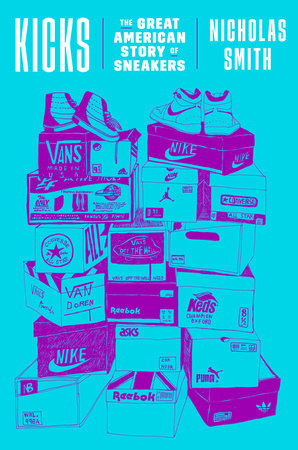
‘Kicks: The Great American Story of Sneakers’ by Nicholas Smith (2018)

While I’m no ‘sneakerhead’ and have appalling fashion sense, runners are the one item of clothing that I  can actually enjoy shopping for.  I’m also the kind of guy who wears black Asics walking to work and doesn’t bother putting on suit shoes unless a meeting is very important so my views on anything shoes or fashion related should probably be ignored. Kicks

I had to ask myself if Kicks qualified as a sports book but given the heavy focus on the history of sport and sports companies, it definitely does.  Kicks traces the story of how sneakers (the American term for runners, trainers, sports shoes or tackies) were first developed and grew from being a sports specific shoe to the ever-present default footwear choice of billions.

In telling the story, Smith traces the origins of numerous sports and even more sport shoe companies.  In particular he captures the rivalries that drove advances in technology and marketing as the sneaker business crossed over from sports wear to mainstream everyday wear.  From Converse v Keds, Addidas v Puma to Nike v Reebok, the battle to be number led to some much innovation and change in an ever growing market.   Each company would at some hit a gold mine – whether the Converse All-Star, the Reebok athletic shoe or Nike Air Jordan – before losing the lead as a competitor signed the next big name or launched the next must have shoe.

The book weaves together a lot of stories I already knew or was vaguely aware of.  I was surprised by how much of the source material I had read including Kenny Moore’s book on Bill Bowerman and the Men of Oregon, Phil Knight’s autobiography Shoe Dog (about Nike) and Pitch Invasion by Barbara Smit on the founding of Adidas and Puma.

airjordan

It also touches on the role non-sport elements popular culture, in particular Run DMC’s promoting of Adidas which landed them a $1 million endorsement deal, had on the marketing of sneakers. Finally, it talks about sneakerhead culture and the fan culture that the internet has enabled resulting in shoes selling for thousands online and sneaker theft becoming a worrying source of crime in US inner-cities. While it seems crazy to think of someone buying shoes they will likely never wear, I’m writing this looking at my library of 100’s of books I’m yet to read while I buy way more new books every year than I read.  I guess we all have a passion and for some people that passion is sneakers.

Overall it is a very interesting dive into the world of American sports shoes that becomes more interesting as you keep reading.  While the book could easily have become a boring repetition of facts, Smith’s writing style keeps it light and entertaining.

sneaker-shopping-addiction-000

‘The Draft: A Year Inside the NFL’s Search for Talent’ by Pete Williams (2006)

The concept of a professional sports draft has always been intensely fascinating to me.  In theory it offers an ideal method to ensure that competitive balance remains in a league, particularly when combined with a salary cap.  Seeing Juventus win their 7th Serie A title in a row recently makes you think what soccer in Europe would be like if youth development was handled by schools and not professional teams and the best players divided up by draft.  It’s clearly not possible, but it would sure be interesting!

the draft

The Draft is a long and detailed account of the 2005 NFL draft told through the experiences of key people at every level – top 10 draft picks, lesser players, Atlanta Falcon’s General Manager, coaches and a whole host of sports agents. It’s a very thorough account that covers every aspect of draft day preparation by all those whose futures are heavily tied up with this two day extravaganza.

It is an interesting read and certainly achieves its goal of shining a light on the draft process.  Reading it at more than 10 years remove is fascinating with some players being instantly familiar from their subsequent achievements in the NFL – particularly someone like 49er’s great Frank Gore who didn’t get picked up until the 3rd round.

Frank Gore

The book’s length however becomes a weakness.  There is a lot of repetition gets tiresome if you read the book over a fairly short period.

The other big weakness of the book is the excessive focus on agents.  While the coverage of the role of agents and their interaction with players is interesting, there is far too much focus on which agents were successful in building their own rosters of players.  It’s very hard to care about which salesman managed to get himself a big payday and the book would have benefited from a lot of this material being cut.

All in all, however, it is an interesting and enjoyable read. It may inadvertently work best as a book to dip into – like a series of newspaper columns – otherwise the excessive detail and repetition could get annoying.

2005nfldraft

‘Moneyball: The Art of Winning an Unfair Game’ by Michael Lewis (2003)

‘Moneyball’ might be the most influential sports books of the last 20 years.  15 years since it was first published, Moneyball is still synonymous with the ever-growing movement to use big data to improve the performance of professional sports teams.

moneyball

Lewis set out to answer the question of why the Oakland A’s consistently outperformed teams with much higher budgets.  He found a much bigger and more fascinating story about a sub-culture of baseball nerds both inside, but mostly outside, the sport who were determined to see the game as it really was.

At the heart of the book is Billy Beane, a former player who never fulfilled what others believed was his potential.  Lewis was given incredible access behind the scenes of the A’s management team as they prepared for a draft and throughout the 2002 season as Beane wheeled and dealed his way to improving his team at every turn.

Beane is a fascinating character  – charismatic but ruthless, a baseball insider who thinks like an outsider, a man obsessed with his team who refuses to watch the team he runs actually play a game.

oakland

The book is utterly engrossing.  Lewis is the master of explaining complex and insider ideas to a layperson.  Despite having a limited interest in baseball, I found the book easy to follow as Lewis leads the reader through the thought process of Beane and the various ‘sabermetricians’ who think more about baseball than anything else.

At the heart of the story is Bill James, a statisician who self published baseball statistics slowly building a fanbase and eventually influencing the next generation of General Managers.  Not being a baseball fan, its hard to grasp just how obsessive James and his followers are.  Being a fan of fantasy football does help me realise how obsessed a fan can become with watching certain players and being desperate to figure out what players are likely to outperfomr others.

Moneyball is an absolute must-read for anyone interested in the future of sport or anyone interested in a good story.  It’s the story of an underdog who out-thinks and therefore out-plays the bigger richer teams.   It’s a great book not just for sports fans, but for anyone who likes stories about disrption and people trying to shake up an established way of doing things.

As well as being a great read, Moneyball has had a significant impact on professional sports since its publication.  Many an article has been written on this over the last 15 years.

Reading Moneyball is a different experience than when I read it over 10 years ago.  Knowing broadly how the draft picks and other players mentioned in the book panned out changes how you experience the story.

moneyball (1)