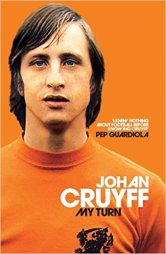
‘My Turn’ by Johan Cruyff (2016)

Cruyff was a genius who played a huge role in reinventing football both as a player and a coach. His death rightly prompted a wave of remembrance and reflection on his achievements.

I was too young to see Cruyff play, or to really remember his greatest teams as a coach.  But his influence has loomed large over my football watching – none more so than Pep Guardiola’s magnificent career at Barca, Bayern and Man City.   In the 90’s Eurosport used to show replays of the best World Cup matches from the 70’s and 80’s with modern commentators acting as if the game was live, yet the players had somehow lived another 20 years. Can’t beat lines like “What will Cruyff do next, oh what a pass, it is such a shame that he doesn’t play in the next World Cup”.

One the first great football books I read was Ajax, Barcelona, Cruyff by Frits-Barend and Henk Van Dorp.  This unusual, intriguing book is the closest we have come to a footballing biography / autobiography of Cruyff before My Turn.  Indeed my early football reading was heavily Dutch/Ajax/Cruyff influenced with Simon Kuper’s Ajax, the Dutch, the War and David Winner’s Brilliant Orange also among the books I read in my late teens/early 20’s – all three books deserve a reread and a separate blog post.   I also have a keen picture of Cruyff from the various Barcelona books I’ve read over the years, none more so than the excellent Barca: A People’s Passion by Jimmy Burns.  What is clear is that almost everyone reading My Turn will have a preconceived notion of Cruyff – brilliant, arrogant, temperamental, power hungry and lots lots more.

cruyff

What is clear is that My Turn could not have been written at any other time in Cruyff’s life.  It is inevitable that his diagnosis with lung cancer led to a period of reflection and consideration of his life’s work.   This book is not a typical footballer’s autobiography.  The book seems to reflect what was on Cruyff’s mind in the years before he died, with more space given over to both the politicking behind the scenes at Ajax from 2010 to 2015 and to Cruyff’s general worldview than is given to the great Ajax side that won 3 European Cups.

His childhood is very much the story of his relationship with Ajax and the many surrogate fathers he found along the way.  He dwells very little on the key matches or moments of his playing career – instead focusing on his relationship with his coaches – the legendary Rinus Michels and the equally important (to Cruyff) Jany Van Der Veen.

The various slights that have led Cruyff to abruptly depart both Barca and Ajax more than once are both covered.  While Cruyff recognises he can be difficult, it is clear Cruyff felt wronged on each occasion and still believes his own actions were the inevitable result of others actions.  He certainly had a sense of his own importance – but then many us are plenty arrogant without 1% of Cruyff’s achievements to back it up.

turn

His discussion on family is fairly limited – with a focus being on Jordi’s playing career and the impact Cruyff’s own moves had on his son – until the final chapter, but his relationship with his wife is clearly the most significant of his life.   At every point, Cruyff describes events through the prism of his relationships with others though  – Nunez at Barcelona, the board at Ajax, the directors at Washington Diplomats etc.

What shines through most of all is Cruyff’s vision of football.  I felt this was a bit lacking in the book until the last 50 pages when Total Football and how to play it is given the space it deserves.  Anyone who has watched Man City play this season (or Guardiola’s previous teams) will clearly recognise the template. His commitment to this style of play and his willingness to fall out with everyone when it is not achieved is somewhat endearing to me.  Having gone to an Ajax game in 2013 and nearly fallen asleep during a 0-0 draw, I certainty understand where he is coming from in his later discussions on the fall of the Ajax he knew and helped to build.

There are some great and slightly odd anecdotes throughout the book – from his desire to sign Cyril Regis at Ajax, to his involvement with the proposal to move Wimbledon to Dublin (as a peace initiative apparently!).

Part of the book is clearly Cruyff’s attempt to shape his legacy.  But is endearing is that to him the Cruyff Foundation is what counts – he shows less interest in reshaping the narrative of his career than I would have expected other than correcting ‘fake news’ as we would call it today.

Its a book that jumps from the story of a great footballer, to that of a great coach, to that of a celebrity searching for a legacy.  Overall, the book is an insight into the mind of one of arguably football’s greatest genius.  Like the man it probably gets too caught up in personality clashes – I’d have loved more detail on the three European Cup winning team – but is also singular in its vision.  In many ways, the book is Cruyff’s last call to action – play football and play it the right way.

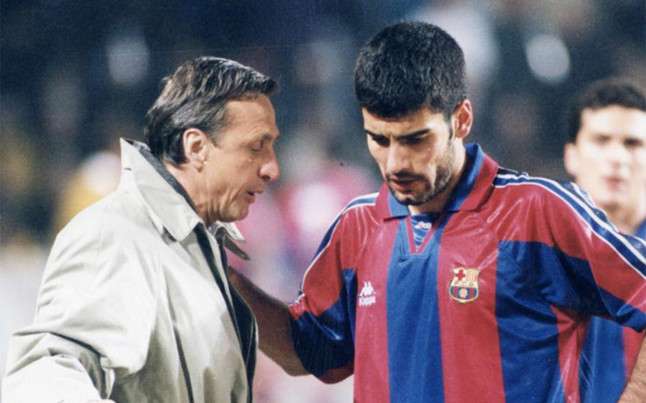
Pep and Cruyff


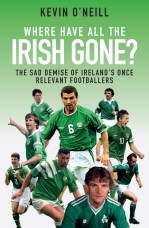
‘Where have all the Irish gone? The sad demise of Ireland’s once relevant footballers’ by Kevin O’Neill (2017)

It goes without question that no player on the current Irish national football team are likely to get signed by Juventus or Inter Milan. Or earn the nickname ‘God’ at a club that has won the European Cup. Or even smash the British transfer record.

Kevin O’Neill’s book, Where have all the Irish gone? The sad demise of Ireland’s once relevant footballers, starts with the important (to Irish football fans) question of why this is the case? Why do we not have players like Liam Brady, Robbie Keane, Paul McGrath, or Roy Keane?

Irish.jpg

O’Neill appears to be very similar to me – Ireland fan, child of the 80’s, who spends too much time thinking about the Ireland team. At times O’Neill is a bit too much like me in that passion may cloud serious analysis.

The answers to the central question – more competition in the Premier League and the total lack of investment in the Irish game/coaches aren’t rocket science but each is discussed in detail.

O’Neill could have done with better editing. The first few chapters jump around from diagnosing the causes of the problem to reliving the glorious past. The book jumps too much – with Liam Brady’s career, for example, talked about in two completely different segments. While parts of the nostalgia trip are enjoyable, it feels a bit too much like reading the wikipedia entries on the careers of Keane, Quinn etc. The chapters are reasonably long and paragraphs flow into each other in a way that jars. A few breaks for new segments would have helped put some structure on what can be a slightly rambling narrative.

brady2.png

The book is at its best in Chapter 3 and 4 when O’Neill interviews a series of people connected to the game who don’t normally get the spotlight shined on them – players who never made it and youth coaches in particular. These chapters add genuine insight in to the challenges for young Irish players and are the best part of the book.

When O’Neill turns his gaze to the FAI and the structures to improve the game, he makes a reasonably simple diagnosis – bring back Brian Kerr (most successful underage manager in our history and a man steeped in the Irish game). However, he then doesn’t point out anything that the man in the job, the wonderfully named Ruud Docktor, is actually doing wrong. It seems O’Neill would just feel more confident if Kerr had the job. While I agree its a disgrace that Kerr is not involved in some capacity with the FAI, I think its a bit too simplistic to point to him as such a major part of any solution. The comparisons to Iceland and Belgium are justified however.

kerr

The book turns to wistful nostalgia of days gone by – when kids played ball on the streets (is it better to be poor but have better footballers to cheer on?). O’Neill talks about some of the great South American players as examples of how street football (poverty?) helps create great players. In reality though, it should probably be pointed out that a continent with more than 400 million people where football is a very popular sport is likely to produce 100 great players for every 1 Irish star.

O’Neill’s passion for Irish football is evident and his worries are genuine. The book gives a good insight into the lives of those who made it and those who didn’t. It doesn’t offer too much in terms of where we should go (beyond Kerr and summer football) – its instead a realistic chronicling of the woes rather than much of a diagnosis for where to go from here.

The interviews in the book capturing many previous unheard voices make it a welcome addition to the library of football books in Ireland. However, I can’t help feeling there is a better book in there waiting to get out.

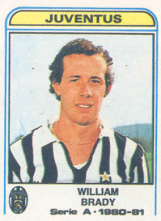
Brady

The good, the great and the gossipy – my favourite basketball books

I’m convinced that every sports fan has an era for each different sport that stands out as the time when they knew so much about the game. When that sport shone brighter than ever and that, when asked to name a favourite ever player, they return to. For many men, I suspect that age is early teens – for me it, it varies per sport a little but its basically the 90s.  In football, it was USA ’94, the Cantona years of the English Premiership, the Milan side of Baresi and Van Basten merging into the team of Desailly and Weah and great the Ajax side of 1995.  In cricket, it was the Ashes in the era when Australia couldn’t be beaten with the likes of  Glenn McGrath, Shane Warne and Ricky Ponting.  In Boxing it was Collins v Eubank in 1995 and Tyson’s post prison career.

In Basketball it was Channel 4’s decision in 1995 to start showing the NBA (three years after the same channel had introduced me to the wonders of 1990’s Serie A) although the 1992 Dream Team which an 8 year old me has bizarrely clear memories of had wet my appetite for some hoops.
nba.png

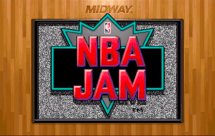
NBA on TV combined with NBA Jam on the Super Nintendo, the Atlanta Olympics and my own 3 game basketball career (one amazing game, one alright game, and one game so bad that I retired from the sport at age 12) meant that very briefly I really loved the NBA. The Bulls of Jordan’s second stint were the dominant team with Shaq led Orlando Magic also a particular favourite. Tim Hardaway, Karl Malone, Tim Duncan and Allan Inversion are the other names that immediately spring to mind. Its only in recent years, through spending a lot of time in the US (particularity during March Madness) and ESPN 30 for 30s that I have rekindled an interest in the sport.

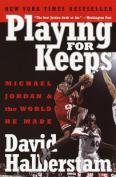
So in reading basketball books I’ve very much been drawn to that era and those players. And in that era one man looms large over basketball and popular culture – Michael “Air” Jordan.  All of which is a long winded way of getting to my first book – Playing for Keeps: Michael Jordan and the World He Made by David Halberstam. Halberstram is a writer I found through this book and I fell in love with his work. I’ve seen Halberstam described as being to sports books what Robert Caro is to political biographies and Paul McGrath is to centre backs (i.e God basically) which I fully agree. He is simply a wonderful writer.
PfK

Playing for Keeps was written before Jordan retired for the second (but not final) time. The book is about Jordan, the phenomenon that was/is Michael Jordan, NBA of the 80s and 90s and the people in that world. Its as much about the impact of Jordan as it is about the actions of Jordan. Halberstram gives plenty of backstory on the various supporting players (Phil Jackson, Scottie Pippen, Dennis Rodman, Larry Bird, the wonderfully entertaining Pistons, just to name a few) to create a full, and compelling portrait of the Bulls and the NBA of the time. The Jordan that emerges is complex, headstrong, incredibly hard working and above all driven – driven perhaps like nobody before or since in any sport. Its a detailed, engrossing read and one that I would recommend to anybody.

My only criticism is that it reads at times a bit too much of a love letter about Jordan – although its hard to think of a sportsman who came to define his sport more than Jordan.  Like all Halberstam’s books it is wonderfully well written and tells as much about the society at the time (particularly the changing US attitudes to race) as it does the protagonist.

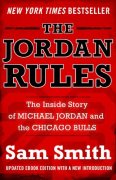
A very different book looking at the Jordon phenomenon is the gossipy and entertaining The Jordan Rules by Sam Smith. The book details the internal workings of the Chicago Bulls during the 1990/91 season as they won their first NBA Championship. Jordan doesn’t come across particularly well. Most surprising to me at least was his attitude to basketball – he seems to really just have wanted to retire and play golf.  There are definitely question marks over how accurate it is – the Fire and Fury of its day when the most famous man in America was thankfully just a sports star!  Its a very different book to Playing for Keeps written by a lesser writer (but who isn’t a lesser writer than Halberstram). But its enjoyable and entertaining.  Its not a classic, but its a fun read and a fascinating snapshot of nearly 30 years ago.
J r.jpg

Jordon looms large in another great basketball book covering the same era, Dream Team by Jack McCallum. Its an enjoyable book on the Dream Team from the 92 Olympics.  It really was some amazing collection of cultural icons with Magic, Micheal Johnson, Larry Bird and Charles Barkley among others.  McCallum had amazing access to the players both at the time and years later – including Jordan who seems to rarely talk to journalists for these type of books.  Brought back some great memories of watching the Barcelona Olympics as an 8 year old and loving both the Dream Team and the amazing multicoloured, Grateful Dead inspired, jerseys worn by recently independent Lithuania.

lith.jpg

A good insight into the players, their relationships with each other and the ultimate impact the team had on basketball.  McCallum recounts many entertaining behind-the-scenes stories of the Dream Teamers when they weren’t defeating their opponents by embarrassingly large margins. The backstage stuff is the value of the book – reading about a 40 point victory isn’t exactly thrilling.

One of the highlights is the coverage of “The Greatest Game that Nobody Ever Saw,” the infamous team practice match that Coach Chuck Daly organized at the team’s practice facility in Monte Carlo. The greatest collection of basketball players ever going at each other. McCallum goes play-by-play through this exhibition, and brings to life on the rare great sports moments you can’t find on youtube!

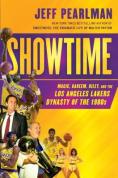
Moving from Jordon to his predecessor as the biggest star in sports – Magic Johnson – another classic is Showtime: Magic, Kareem, Riley, and the Los Angeles Lakers Dynasty of the 1980s by Jeff Pearlman.  I never liked the Lakers. I started watching the sport after the Showtime era and I can’t help feeling I may have liked them a lot more had I been a little older. Showtime covers the team that won five championships in a 9-year span. It tells the story of the great team led by Pat Riley that dominated the sport before the lulls of the 1990s and the return to the top under Phil Jackson.
sh

Pearlman has carved a bit of a niche in chronicling the bad guys in sport – with previous books Boys will be Boys and the Bad Guys Won covering the questionably behaved Cowboys and Mets.  His books are gossipy and entertaining – definitely more Jordon Rules than Playing for Keeps – and I love them. Pearlman does a great job of bringing the the 80’s era Lakers to life – from the beginning to the sad (but thankfully not tragic) end when Magic announced his HIV diagnosis. It is a very entertaining read which pulls no punches – a lot of drugs and a lot of women – through many interesting and sensational anecdotes. Who wants to read about a well behaved team after all?

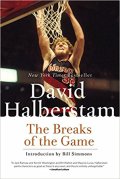
A number of the players who are veterans in Showtime also featured heavily in David Halberstram’s other basketball masterpiece Breaks of the Game.  Younger versions of Kareem and Jerry West are key players which makes this a fascinating companion piece with Showtime. That and the fact that the writing styles are very different – broadsheet vs tabloid to some degree (while both still excellent books). Breaks of the Game is one of the all time great sports books.  Halberstram follows the Portland Trail Blazers NBA team for a season in the 80s.  The book chronicles the teams slow decline rather than the earlier rise. At the heart of the book is Bill Walton, the supremely talented, politically active, white centre – a college legend whose pro career was more injury dominated than dominant on the court.

The book captured an era of change – the birth of the modern NBA. Magic and Bird were rookies, the NBA had swallowed the ABA and more and more black players were being signed and leading teams. The team and players are used as means to explore every aspect of NBA life – money, the strains of the season, injuries and most of all race. Simply wonderful writing and a fascinating study of America and pro sports at the time.
BoTG

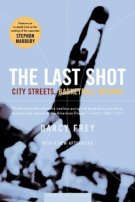
Away from the pros, its arguable that even better books can be found – great books on high school hoops offer a slice of American life that is compelling, depressing and all to common.  Very recently I read the The Last Shot: City Streets, Basketball Dreams by Darcy Frey. First published in 1994, the book looks at Lincoln High School in Coney Island, New York – a deprived area that became heavily ghettoised from the 70’s on. The book focuses on 3 incoming high school seniors with huge potential and the possibility of college. The 4th star is a 14 year future NBA star Stephen Maybury.  Its a gritty and dark look at life in the projects and the depressing reality that only sport offers a potential escape to the lucky few. The book contains very little game by game action and highlights that the attempts to get a high enough mark in the SATs after years of educational neglect is a bigger challenge and far more important than any city or State title. The 2004 version contains an epilogue of where the players ended up which puts a new slant on the story.  Well written, thoughtful, compelling and insightful, it deserves its place on the list of greatest sports books.  last shot
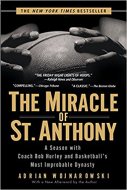
But there may be a high school book that sits above it in the pantheon – The Miracle of St. Anthony: A Season with Coach Bob Hurley and Basketball’s Most Improbable Dynasty by Adrian Wojnarowski.   I adore this book and am desperate to reread it once I figure out who I lent it to!  Wojnarowski follows legendary Coach Bob Hurley and his St. Anthony High School team through an incredible season.  Not only is the writing fantastic but the story is amazing.  Hurley is an old school coach who motivates through discipline but his loyalty to his players and his determination to improve their lives is inspiring.  The season plays out like a novel keeping the reader gripped as the life stories of the coach, the sisters who run the school and the players unfold.
st an

A number of the books above are due a reread, and there are a number of basketball books on the to-read pile – I plan to do individual blog posts for each book and eventually update / repost this.

Championship Manager, Kindle Unlimited and a nostalgia trip

I only read cheap books on the kindle – those that look interesting and pop up on the regular kindle sales. I now have 100’s of books on the kindle – and growing at a much faster rate than I read. I’ve been reading mostly on the kindle this week as I somehow accidentally signed up to Kindle Unlimited – a Netflix style book rental service of (mostly terrible) books. I cancelled as soon as I saw the charge but it means I have 3 or 4 weeks of access to the 1000’s and 1000’s of (mostly terrible) books.

Given that this happened just as I started this blog, it made sense to investigate the Sports books available on Kindle Unlimited.  There are a few old classics that I read many years ago that turn up on best of lists – including the excellent Morbo – The Story of Spanish Football by Phil Ball and Tor! The Story of German Football by Ulrich Hesse-Lichtenberger both of which I read not long after they came out in 2003. I even re-read Tor! shortly before going to the World Cup in Germany 2006 (supporting the Mighty Sparowhawks of Togo). I remember reading it an wondering if I could actually be any more of a nerd, though I’ve since topped this by spending most of a lads holiday in Thailand reading Inverting the Pyramid.  Also available is The Real Deal by Jimmy Burns – a re-branded slightly re-edited version of his decent “When Beckham Went to Spain”.

There seem to be a few other interesting books available that I haven’t read – Roger Kahn’s less famous baseball books, an interesting looking book on football in North Korea by Tim Hartley and a tennis book called The Courts of Babylon by Peter Bodo. The book that jumped out the most was Fall River Dreams by Bill Reynolds – a book that I haven’t read that is often compared to The Last Shot: City Streets, Basketball Dreams by Darcy Frey which I love. So it looked like my Kindle Unlimited error would at least yield one new book I really wanted to read.

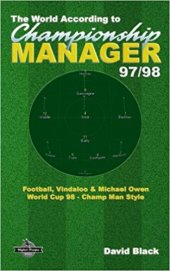
But, and its the reason I’ve struggled with library books, I hate feeling like I have to read a particular book right now or I won’t be able to read it next week/month – it makes me resent the book.  So…. given a turbulent week in work, I felt like pure escapism and I knew that I couldn’t resist The World According to Championship Manager 97/98 by David Black. I can’t imagine I would ever have paid the princely €2.99 normal asking price for this – but I couldn’t resist free access.  Championship Manager is/was a football management computer game. You pick a team, buy players, set formations, then watch as the computer tells you – in text form – how your team do in each game. Its football by spreadsheet.  I loved it when I was a kid. I was addicted to it. I still remember my best save games in more detail than almost anything else about my childhood.

Champ 97

I still played the newer versions when I travel with work – until I had to stop as I was staying up till 4 am to see if I could get Exeter to the Champions League.  I couldn’t get the mighty Grecians past second in the Premiership and Champions League semi-final so I took the challenge of combining the Chelsea job with taking Ireland to 2026 World Cup. (I retired on the spot the day Ireland lost 7 – 0 to England in the World Cup quarter final and haven’t played the game since).  But I’ll never love any game as much as I loved the 97/98 version – although 2001/02 is definitely the more popular retro version.

So rather than read a book I’ve been meaning to pick up, I used my unwanted free access to delve in to a pure nostalgia fest. The book is unquestionably objectively terrible – mostly recounting matches simulated in the authors computer as he attempts to win the World Cup with an England team led by Alan Shearer and Tony Adams.  I don’t really understand why the book exists, but I enjoyed it. The names, the transfers, the memories, the emotions. It only took about an hour to read and I consider it an hour well spent.

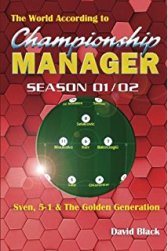
The really shameful behaviour is that I didn’t then start Fall River Dreams. No, I opted for The World According to Championship Manager 01/02 by David Black.  Just reread the review of the last book (paragraph above) to find out what this book was like – except this book had even worse editing. As in every tenth page has a sentence that makes no sense.  But again I enjoyed it – there is something wonderful about reliving a very important part of your childhood. I can name more SerieA and La Liga players from that era than I can today – despite still watching plenty of football.

Champ 01

While on the subject of where football management computer games and books crossover, a more polished, and more ambitious book on Football Manager (the rebanded name for Champ Manager) that I read a few years back was Football Manager Stole My Life by Iain Macintosh.  This book was at its best when telling the story of the development of the game, interviewing its Founding Fathers as well as some legendary players whose real life never quite lived up to their online avatars. Some parts of the book just don’t quite land- especially the fan fiction at the end. The stories of obsessive fans of the game felt familiar and had definitely heard them before – I’m proud to say I never put on a suit for a cup final but I did hold a daily press conference in my head on my walk to school everyday.

A major weakness is that book is not as good as the very enjoyable documentary – Football Manager: An Alternative Reality – which coves the same ground but in a more engaging manner. Ultimately it feels a bit like an opportunist stocking filler – a phrase which 100% describes the dreadful The Football Manager’s Guide to Football Management also by Mr. Macintosh – who is a  better journalist/podcaster than a book writer. Ostensibly a book that is meant to explore the Game (football) through the eyes of a game (Football Manager), it isn’t really a ‘Football Manager guide’ to anything. It’s a very English bloke’s guide to football management (in a blokey FHM lads mag style mannner) with a few references to Football Manager thrown in to convince suckers like me to ask my Mum for it for Christmas (at age 30 years and 4 months).

So the moral of the story is that the great football management simulation computer game book is yet to be written.  And don’t buy Kindle Unlimited.

FM stole my life

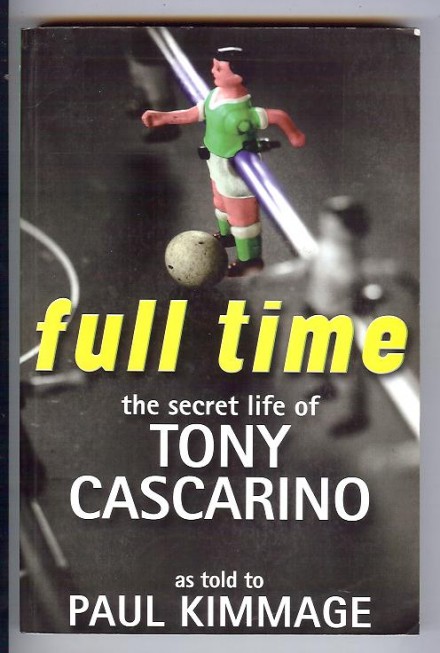
‘Full Time: The Secret Life Of Tony Cascarino’ by Paul Kimmage (2000)

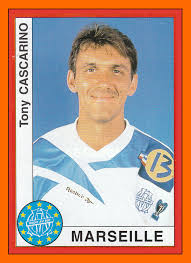
I’ve always loved Tony Cascarino. From the joy of an Italian named striker playing for Ireland, his 7 goals in our ill fated qualification group for 98 World Cup and the sheer strangeness of an Irish player playing his club football in France. While I remember bits of Italia 90, my real (as in total recall of where I was and how it all felt) football memory begins with the final qualifier in Windsor Park for the 94 World Cup. By that time Cascarino was half way through his Ireland career, and his best days were presumed to be behind him – but his resurgence at club level in France and his goals in World Cup qualifying (albeit against pretty crap teams), meant he was one of my favourite Irish players.

I bought Full Time as soon as it came out in 2001 – at a time I was finally old enough to travel to Ireland games in Dublin with my mates.  The Irish team became my sporting passion as we cruised to Japan / Korea.  I read Full Time over one night, staying up all night and suffering like hell in school the next day. I couldn’t believe how good the book was. 17 year old me was definitely very shocked by the candid admissions of his demons, his affairs and his inner self doubt. I read Rough Ride immediately after it and became a huge fan of Kimmage (to my mind the best sports interviewer I’ve read with the possible exception of the great Donald Mcrae).

fulltime

Rereading it this week, it struck me that the book is even better than I remember. Its short, its personal, and its very very honest – Cascarino does not present himself as a nice guy but rather as who he is – a complicated, compelling figure who has made a lot of mistakes.   It is easy to judge him but the fact that Cascarino wanted his true self to be displayed is what makes the book so fascinating.  None of us are all good or all bad – but we don’t usually publish books about arguably the worst things we have done.

The book jumps through different periods in Cascarino’s life with the first quarter painting a picture of his recent life (as of 1999/2000) – his new life in France at Nancy, his new family life with his French partner and their child and his later days in the Ireland squad. Already we are introduced to his inner critic – the little voice in his head that tells him he is crap at very unfortunate moments. Its Chapter 5 before we hit the backstory of his childhood – which is told very quickly and focuses on his Dad, Dominic.

News report when it emerged Cascarino never qualified to play for Ireland

The story of his early career is told in a brilliant engaging manner – as much about his self doubt, his growing ego and the his relationship with others – like Teddy Sheringham at Gillingham, Niall Quinn and Jack Charlton at Ireland, Glenn Hoddle at Chelsea and Liam Brady at Celtic.  The stories with the Ireland team paint a great picture of the team that Jack built – but Cascarino remains the focus of the narrative throughout. Most strikingly, once Cascarino pulled a muscle in the build up to USA 94, he doesn’t even mention the game he played in (2nd round exit v Holland) but is straight into the unlikely tale of how he signed for the defending European Champions.

The days of “Tony Goal” in France are the most interesting football wise for me – as he bangs in goals while being unforgivably bad as a husband and father.

Tony

Ultimately, its a difficult read with a happy ending (for Tony) tinged with sadness (for others mostly) – on the pitch in France he ended with a great performance but with Nancy still being relegated. Off the pitch he committed to a new family but the impact of his behaviour on his ex and first two kids still a long long way from healing.   Ultimately, it feels like the writing of the book and the searingly honest admissions it contains is Tony’s attempt and understanding himself.

Kimmage’s quality as a writer really shines through in the books narrative structure – the use of two separate series of diary entries captures the Tony of 1999/2000, and the telling of his life through the rest of the book helps explain how he became the man he is.

As Eamonn Dunphy said of this book, if it was fiction it would win the Booker Prize. It is as much about life as it is about football.  It is a book I will reread every few years and enjoy every single time.

The closest we have ever come to a sequel to Full Time is a 2014 interview between Kimmage and Cascarino that updates a bit on Tony’s life since 2001.   A book is also coloured by what happens next so don’t read it until after you finish Full Time.

The best books (I’ve read) on Muhammad Ali

Not all of these books are specifically about Ali, but he is a central figure in all of them.  For those who just want a list:

  • King of the World: Muhammad Ali and the Rise of an American Hero (1998) by David Remnick
  • Rome 1960: The Olympics That Changed the World (2008) by David Maraniss
  • Night Train (2000) by Nick Tosches
  • Drama in the Bahama’s (2016) by Dave Hannigan
  • The Big Fight (2002) by Dave Hannigan
  • Ali: A Life (2017) by Joathan Eig

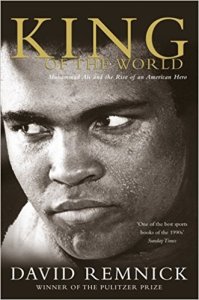
My cousin boxed for Ireland as a youngster and just missed out on the Atlanta Olympics.  My uncle, is father, was my intro to boxing and to boxing books.  I was first exposed to Muhammad Ali as a young kid watching some old tapes in my uncles house.  I remember thinking that how can he be the greatest when he lost so many times.  Surely “undefeated champion” beats “multiple times champion” every day of the week.  I remember watching Ali light the Olympic flame in Atlanta as a 12 year old and wondering why this guy was the hero, why was he loved so much by so many.  Then I read King of the World: Muhammad Ali and the Rise of an American Hero (1998) by David Remnick.

Ali

Its been over 15 years since I read this book, not long after it was first published. As anyone who has read any Remnick will know, its written with the style and with the imagination that has characterised all of his work. It is a wonderful book.

It was one of the first books I read that put any sportsman in the cultural context in which they operated.  The majority of the book deals with the time-frame between Ali’s (then Cassius Clay) first heavyweight title fight against Sonny Liston, and the rematch between Liston & Ali.

I remember the vivid descriptions of Floyd Patterson – an incredibly sympathetic figure for a world heavyweight champion.  Sonny Liston too looms large in the book.  Most of all what struck me was that Remnick showed that great sportsmen are a lot more like you and me than we often think.   Remnick captured some of Ali’s lightening in a bottle and the reasons he became such a dominant cultural figure.   It showed me why, and how, a black man who converted to Islam and refused to fight became a cultural hero in a US where racism, love of military and fear of Islam have always been, and remain, at the very heart of the nation’s psyche. On a personal level, he showed me that sports books can tell you as much about a time and a place as any of the greatest literature.  A re-read is long overdue (along with a more detailed review).

Since then, Ali has loomed large in other boxing books I’ve read and loved – as the young brash Olympian in Rome 1960: The Olympics That Changed the World (2008) by David Maraniss.  It captures the attractiveness of young Cassisus Clay and hints at the man he would become.  In Night Train (2000), Nick Tosches dark and wonderful book about Sonny Liston, life and the American Dream, Ali serves a counterpoint to the often overlooked and unloved Liston.  In Dave Hannigan’s excellent Drama in the Bahama’s (2016) he is the pitiful exploited figure unable and unwilling to listen to reason and call time on his wonderful career.

Hannigan previous book, The Big Fight (2002) chronicles a week that Muhammad Ali spent in Dublin and his fight with fight Al “Blue” Lewis in Croke Park in July 1972.  Hannigan tells the story of Ali in Ireland through the experiences of those who saw, met and interacted with him in Dublin.  At the time, Ali was on the comeback trail following his first fight, and loss, to Joe Frazier.  Given his long lay off while he refused to be drafted into the U.S. Army, it was unclear whether Ali would ever be the same fighter he once was.  He was still just 30 years of age however and it would turn out that his biggest days remained ahead of him.  He was, and would remain for a long time, the single biggest and best known figure in world sport.

The Big Fight captures the magic and charisma of Ali while also capturing some of the magic and uniqueness of Ireland. It is hard to imagine any figure capturing quite the same attention and affection that Ali did – perhaps only the reception achieved by another famous African-American with distant Irish heritage, Barack Obama, compares.

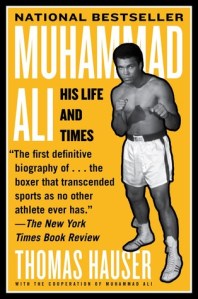
Shortly after Ali’s death, I saw repeated reference’s to Thomas Hauser’s iconic Muhammad Ali: His Life and Times (1991) as the definitive book on Ali.  Regularly cited as the greatest book about the Greatest, I read it almost immediately.  It deserves every word of praise it receives.

Ali Hauser

Hauser’s genius is to present the reader with a unique compilation of different peoples’ accounts of Ali throughout his career and life.   The book presents Ali as who he was to those who experienced him – as well as adding many of Ali’s own words.  Hauser knows when to step away and let the protagonists tell their own tale.  He presents the good, the bad, and the ugly.  His wonderful skill, his bravery, his commitment, his beauty, his pacifism and his words.  And also his mistreatment of women, his misguided behaviour while in the Nation of Islam and his need to keep fighting when it was clearly the wrong thing to do. By the end of the book, a hero emerges. His kindness, his grace, his love shines through.

More recently, I read Ali: A Life (2017) by Joathan Eig.  Its an extremely enjoyable and detailed book that deserves to be mentioned alongside the work of Remnick and Hauser but doesn’t quite reach their heights.  

ALi Eig

I was a bit sceptical as to the need for a new bio of one of the worlds most written about men. The wonderful cover of the book made me curious however and I wasn’t disappointed. Eig had superb access to the remaining members of the Ali entourage as well as access to huge volumes of new material, including FBI materials and analysis of the punches taken by Ali.  This new insight makes the book a welcome addition to the chronicles of Ali.

The book is an honest account of Ali, his contradictions and his genius. It captures what he meant to his time and place and why his legacy is so enduring.  It is a thoroughly enjoyable read and given its scope – being the first major biography published after Ali’s death, I highly recommend it as a one stop source in Ali’s incredible life. It is a book best read while pausing at the retelling each fight to watch the action on YouTube then savouring the description on the page. 

By his later years, Ali became a figure upon whom millions projected the characteristics they wanted their hero’s to have.   What is clear is only a very special person could have chosen the path Ali did.  Only a very special person could have touched so many people – only a very special person could declare himself the Greatest, then make it clear that that was an understatement.

Ali’s story is also the story of his time and place.  He held up a mirror to the America he found – and dragged many people with him towards developing a more tolerant more loving worldview.  For a man who punched people for a living and once preached radical racial separation, its quite the achievement.

Open by Andre Agassi (2009)

First up is a reread of Open by Andre Agassi, a book that regularly makes the various lists of best ever sports books.  For now, I’ve written my thoughts based on how I remember the book from when I first read it more than 7 years ago.  I’m about to start re-reading it and will update the post after I finish.

Open

Sometimes the right book comes into your life at the right time – this is that book for me. This book had a significant impact on me.  I read it at a low point in my life when I was very overweight, miserable in my job and eager for change.  I was on 3 months study leave from work to study for accounting exams and determined to use the time to lose weight.   I managed to drop a huge amount of weight that summer, and the following year – get significantly fitter, meet my now wife and reach a much happier place in my life.  I also did pretty damn well in those exams.

What I know is I loved this book – I genuinely believe it had a major impact on my finally being successful at losing weight and keeping it off (although I’ve put a lot back on in last couple of years which has prompted the re-read.  I’m eager to discover if it lives up to my memory.

What I remember is a brilliantly well written and searingly honest account of Agassi’s life.  His struggles with hating tennis, hating his father and substance abuse were striking.   His ability to turn his life around and become a better player post 30 than before was remarkable, but 7 years removed all I can really remember is that I recommended the book to many many many people.  Will update as soon as reread is complete.

UPDATE

I reread Open over two nights – its as good if not better than I remembered.

From the first pages, its immediately obvious that it is first and foremost a very well written book.  There a huge number of memorable lines in the introduction alone.   The repetition of Agassi’s hatred of tennis is striking and makes it clear this is a book about the man as much as the sportsman.

It feels very honest – you believe this is the real Agassi, the Agassi that his friends saw but that he kept hidden from the rest of the world.  The contrast between the public image and the private thoughts of young Agassi is almost unbelievable.

The first two thirds of the book – his young life and early professional career is the journey of a young man who seems to have the greatest of lives but is struggling deep down.  It think it wonderfully captures the feelings of someone who who ostensibly has a good career but struggles day to day with the Why? We want to believe “successful” people are happy because then, if we are successful, we will be happy too.   Agassi reminds us that “success” is deeply personal and many of us never fully grasp that or what our own personal victory looks like.

Aggassi

While I loved reading this again, I did begin to wonder why this had such an impact on me other than being a really great book.  And then I read this piece at the beginning of Chapter 21:

“Change.  Time to change Andre.  You can’t go on like this.  Change, change, change – I say this word to myself several times a day, every day, while buttering my morning toast, while brushing my teeth, less as a warning than as a soothing chant.  For from depressing me, or shaming me, the idea that I must change completely, from top to bottom, brings me back to centre. For once I don’t hear that nagging self-doubt that follows every personal resolution.  I won’t fail this time, I can’t because its now or never.  The idea of stagnating, of remaining this Andre the rest of my life, that’s what I find truly depressing and shameful”. 

I can remember the impact that paragraph, and particularly the last line had on me.  It was visceral, it was like reading my own thoughts.  It spoke to me, like very few books every have.  So the experience of this book was deeply personal for me and my review is obviously impacted as a result.

However, besides the personal relevance, it is a wonderful book.  I have read a lot of autobiographies, as this blog will hopefully eventually show, and this really does stand head and shoulders above so many others.

The final third – Agassi getting his life back on track, and his late career resurgence is a feel good redemption story.   His coming to grips with finding himself down a path he never chose is inspiring.  He figured out what his own goal was, what he wanted for himself – to win all 4 grand slams – and achieved something that was for him.

Mostly though, this book is about love.  The misguided love of Agassi’s father.  The love between brothers, between friends, between those who come into our life when we need them most.  And the overriding importance of being with the right partner.  I was single when I first read Open and his telling of his relationship with Steffi Graff felt conjured, too adorable and manufactured, the one thing that didn’t ring true.  Then I met my wife and I realised some people do actually get that lucky.

Andre Agassi and Steffi Graf at the Savoy Hotel for Wimbledon Winners Ball

It won’t be another 7 years before I read this again.

The Journey Begins

Thanks for joining me! This site will contain reviews of sports books (classic and contemporary).  I plan to reread old favourites as well as new books that are published.  Aim is to cover a wide variety of sports. I tend to read multiple books at once so a number of books will be on the go at any one time.

I have read a lot of sports books over the years.  But I’ve definitely missed a few of the classics and looking forward to getting stuck in to a wide variety classics as well as random books from the €1 second hand bin!

Its gonna be primarily two types of posts – reviews of books I’ve just read but I also plan to take a topical approach to the books I’ve read and loved over the years – and some that weren’t so great.  Expect posts on boxing, basketball, football, Italia 90 and many more.

If you have a favourite sports book that may not be known to many people, please leave a comment.  Always seeking out new classics that I’ve somehow never managed to read.

cropped-sports-books1.png